
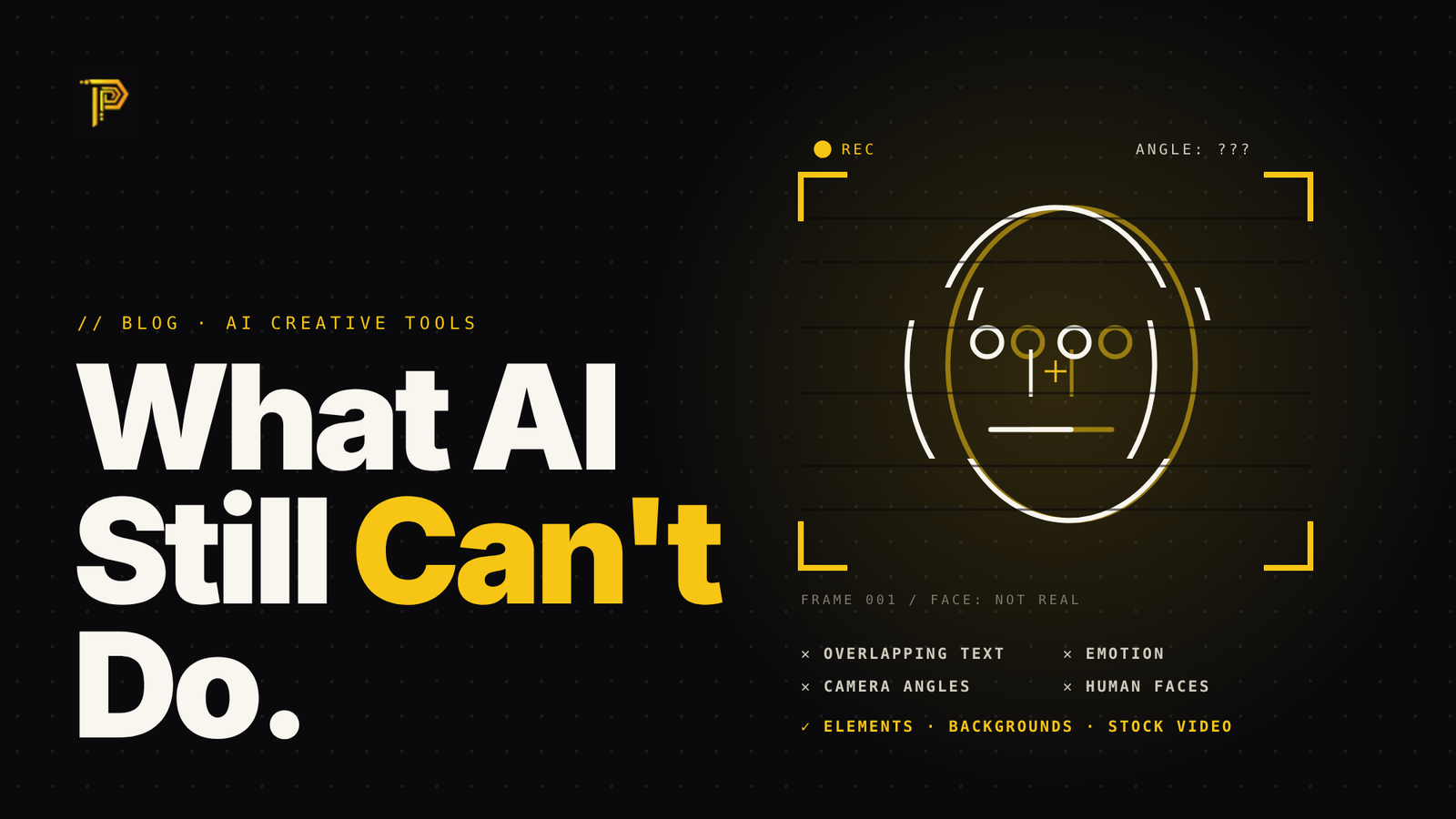
This is based on my own experience, so take it with a grain of salt. I'm not an AI engineer. I'm just someone who has used AI tools to make images, video, and animation in seconds, and then spent far longer fixing the results. Here are the questions I kept asking, and the answers I landed on.
Can AI handle overlapping text?
Not accurately. When words sit on top of other elements, letters warp, spacing drifts, and layers collide. If your design depends on clean typography, you'll end up rebuilding the text by hand anyway.
Little tip: generate the image without any text, then add the words yourself in Canva or Photoshop. You'll thank me later.
Is AI good for photo manipulation?
Probably not the best option. It can edit an image, but fine retouching, exact masking, and subtle tweaks still come out cleaner in traditional editing software, where you control every pixel instead of hoping the model reads your request correctly.
Little tip: use AI for the rough idea, then finish the job in a proper editor.
Does AI understand camera angles?
Not through prompts. Type "low-angle shot" or "over-the-shoulder view" and the result is a gamble. Models don't reliably understand cinematography language, so the framing in your head rarely matches the one you get, even if you describe the shot ten different ways.
Little tip: upload a reference image instead of describing the angle.
Is AI good at animation?
Only really for motion graphics, like moving shapes, kinetic text, and abstract transitions. Character animation or storytelling that needs timing, weight, and intent often comes out stiff or unpredictable.
Can AI drive emotion?
This is probably its biggest gap. AI content can look polished and still leave the viewer cold. Emotion comes from specific choices, like a pause held a beat too long, a glance, or a bit of imperfection. Models average out patterns, and averages rarely move anyone.
Are AI-generated human faces relatable?
Not really. They look almost right but not quite real: skin that's too smooth, expressions that don't match the moment, and eyes with no life. Because they feel artificial, audiences struggle to connect, and for brands built on trust, that gap matters.
So what is AI good for?
Elements, backgrounds, and stock-style videos. Need a moody skyline, a textured backdrop, or a few seconds of generic B-roll? AI can make it in minutes, with no shoot and no stock subscription. Just use it for supporting material, not the emotional centre of a piece.
The short version
Let AI handle the elements, backgrounds, and filler footage, and keep humans in charge of text, framing, emotion, and faces. Use it that way, and you get the speed without losing the quality your audience expects.