
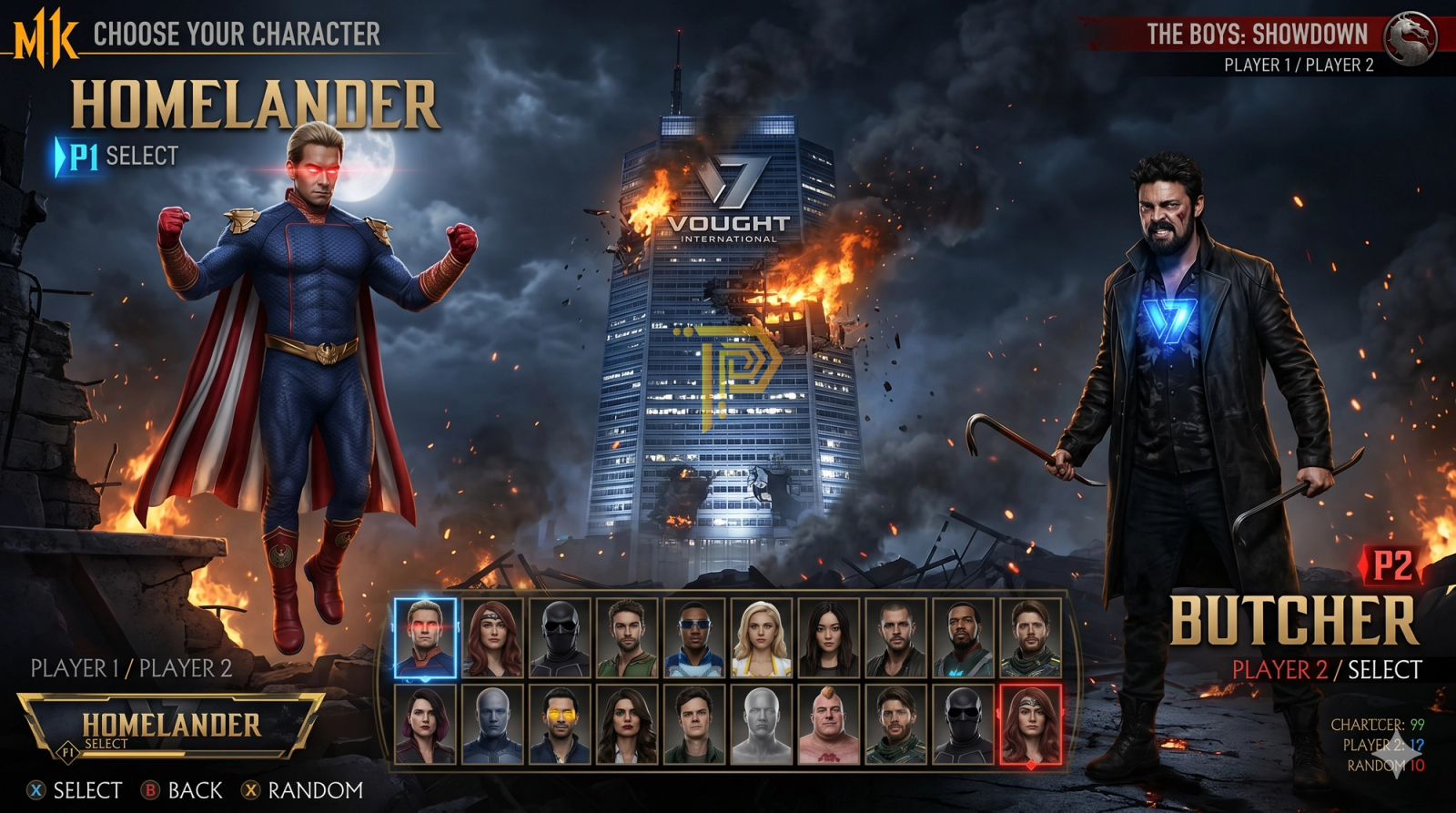
Fantasy Fighting Games Nobody Built Yet — And Why They Should Have
Mortal Kombat has Omni-Man. Injustice has Batman. Great. But what about everybody else?
A Brief History of Fighting Games
Before we build the rosters we actually want, it helps to understand how the genre got here. Fighting games did not arrive polished. They were built through iteration, competition, and a lot of broken controllers.
The Origin: Karate Champ (1984)
The genre traces its commercial roots to Karate Champ, a 1984 arcade cabinet by Data East. It was simple — two players, one-on-one, stick controls. But it established the architecture that every fighting game since has borrowed: a closed arena, two opponents, and movement that rewarded timing over button-mashing. It was modest, but it planted a flag.
The Catalyst: Street Fighter II (1991)
Nothing in gaming history changed the fighting genre the way Street Fighter II did. Capcom’s 1991 arcade release introduced the six-button layout, unique character movesets, special move inputs, and the competitive 2-player format that became the genre’s DNA. It invented the language. Hadouken. Shoryuken. Combo. These were new words in 1991.
Street Fighter II did not just sell well — it created a culture. Arcades became arenas. Strangers became rivals. The competitive community that exists today traces a direct line back to this game.
The Violence Wars: Mortal Kombat (1992)
Mortal Kombat arrived a year later and did something Street Fighter had not: it leaned into brutality as a feature. Digitized actors, hyper-realistic blood, and Fatalities — finishing moves that ended matches with cinematic violence. It horrified parents and thrilled teenagers, and it triggered congressional hearings that ultimately led to the creation of the ESRB rating system in 1994.
Mortal Kombat’s real contribution to the genre was storytelling. The game had lore — realms, mythologies, character histories. It turned a fighting game into a universe. That distinction matters when you consider how it eventually became the first major fighting game to pull IP from other franchises.
The Technical Era: Tekken, Virtua Fighter, and the Move to 3D (1993–1997)
As 2D fighters refined their craft, Sega and Namco pushed into three dimensions. Virtua Fighter (1993) was the first fully polygonal fighting game, introducing sidestep mechanics and a physics-based combat system that rewarded technical understanding over memorized combos. Tekken followed in 1994, adding deeper character archetypes and a narrative structure that evolved with each instalment.
This era split the community into camps — 2D purists versus 3D converts — and both camps are still arguing today. The technical ceiling of Tekken in particular became a defining cultural marker: players who mastered it were respected in a way that crossed into other gaming subcultures.
The Smash Disruption: Super Smash Bros. (1999)
Nintendo’s Super Smash Bros. did not follow the genre’s rules. No health bars. No special move inputs. Platform-based ring-outs instead of KOs. It was accessible in a way traditional fighters were not, and it brought in an entirely new audience. More importantly, it proved that IP crossover worked at scale — Mario fighting Link fighting Pikachu was absurd, and people loved it precisely because it was absurd.
Smash Bros. quietly validated the entire premise of this article: take beloved characters from separate universes, give them a fighting game engine, and let the arguments begin.
The DC Experiment: Injustice (2013) and the IP Era
NetherRealm Studios — the team behind modern Mortal Kombat — took the IP crossover idea to its logical conclusion with Injustice: Gods Among Us. A fully licensed DC Comics fighting game with a real narrative, cinematic presentation, and a roster built from decades of comic book mythology. It worked. It sold. It proved the genre could carry blockbuster IP with the same seriousness as a film adaptation.
When Mortal Kombat 11 later included Omni-Man, Homelander, and Peacemaker as DLC characters, the genre had fully entered the age of IP integration. The question stopped being whether crossovers worked and became: who else deserves a slot?
Invincible VS and the IP Fighting Game Arrives (2026)
Which brings us to the moment the genre had been building toward without quite knowing it. Invincible VS — developed by Quarter Up and published by Skybound Games — launched on April 30, 2026 for PS5, Xbox Series X|S, and PC. A 3v3 tag fighter with 18 base characters, full voice cast from the Amazon Prime series, rollback netcode, and an original character — Ella Mental — created specifically for the game in collaboration with Robert Kirkman himself.
It is the first fully licensed fighting game built around a modern superhero animated series that is not DC, not Marvel, and not Nintendo. The active tag system — switching characters mid-combo to extend pressure — proves that the Invincible universe has exactly the kind of stacked, mismatched roster that fighting game design demands. The power gap between top-tier and bottom-tier characters is enormous, and the community is already arguing about it.
It also validates something this genre has resisted admitting for thirty years: you do not need to be a legacy franchise to carry a fighting game. You just need the right characters and the right developer.
Where We Are Now
Today, the fighting game genre sits at an interesting crossroads. The competitive community is larger and more global than ever. Streaming has made high-level play watchable and aspirational. IP crossovers have normalized the idea of fictional universes colliding in a tournament bracket.
Invincible VS just opened a door. The really interesting question is what walks through it next — and which universes that have never been touched are sitting on the same untapped potential.
That is what the rest of this document is for.
Part II: The Dream Rosters
Fighting games are the most honest measure of a character. Either they have enough identity, power mythology, and style to carry a 1v1 — or they don’t. Below are five universes sitting on untouched gold, with the rosters, tier breakdowns, and the arguments that would light the community on fire.
The blueprints exist. Someone just has to build the game.
01 — The Boys
Amazon Prime · Garth Ennis · Corporate superheroes gone catastrophically wrong
The Boys is secretly perfect for a fighting game because half the roster has no business being in one — and that’s the point. Homelander vs. Butcher with a crowbar is not a fair fight. But nobody plays fighting games for fairness.
Hot Take: Black Noir is the most dangerous character in this game and casual players will never see it coming. No voice lines means no taunts, no tells, no personality — just inputs. The players who main him would be insufferable online. You know exactly who picks him.
The Crossover Match Nobody Asked For: Homelander vs. Omni-Man. Two fascist supersoldiers who genuinely believe they’re the most important person in the room. Same archetype, completely different energy. Omni-Man has the edge — he’s fought actual wars. Homelander has only ever punched people who couldn’t fight back. Give Omni-Man round 1. Give Homelander the crowd reaction.
02 — Avatar: The Last Airbender
Nickelodeon · The greatest animated show ever made · Don’t argue
Avatar is the most mechanically rich universe on this list. Four bending styles, each with completely different combat logic. A game where every element has its own movement system? That’s not a game — that’s an obsession waiting to happen.
Hot Take: Katara with bloodbending active is the most disturbing fighter concept on this list. A time-of-day mechanic that changes her entire moveset at night? The community would either love it or demand it be removed from tournaments. Probably both simultaneously.
03 — One Punch Man
Manga · ONE · The joke IS the lore
The irony of One Punch Man in a fighting game is beautiful. Saitama ends every fight in one hit — so how do you balance that? You don’t. You make it a mechanic. One random button, somewhere in his moveset, is an instant KO. Nobody knows which one. That’s the game.
Hot Take: Garou is actually the most oppressive fighter here. A mechanic where he adapts to your playstyle and counters it harder every round is the kind of thing that gets patched out in week two. Saitama gets the memes. Garou wins the tournaments.
04 — Generator Rex
Cartoon Network · Man of Action · Criminally underrated
Generator Rex is the most underrated entry on this list. Rex literally grows weapons and machines from his body on demand — that’s not a character, that’s a fighting game engine. And the EVOs? Each one is a completely different moveset waiting to happen.
Hot Take: Agent Six should not be a B-story character — he should be the face of this game. A man who fights Providence-level threats with two katanas and zero superpowers? That’s a fighting game protagonist. Rex is the playable tutorial. Six is what you’re building toward.
So Who Actually Wins?
If we are being honest, the Darkness Devil ends this list in round one and nobody comes back from that. Garou would study the technique and try to counter it by round three, which is admirable. The real answer is that nobody wins yet, because most of these games have not been built. And that is the actual crime here.
The fighting game genre is sitting on the most untapped roster potential in entertainment history.
Chainsaw Man has a Devil for every playstyle imaginable. Avatar has four mechanically distinct combat systems built into its lore. One Punch Man has a joke mechanic that is also genuinely terrifying game design. Generator Rex has a weapon-swap system that would feel fresh in any year. The Boys has the most unbalanced roster ever conceived, and that instability is the fun.
The blueprints exist. The characters exist. The demand exists.
Someone just has to build the game.
Drop your dream matchup. We’re just getting started.
Project Digital tracks the patterns between gaming, culture, and entertainment — because the connections are always there if you know where to look. Follow along.