
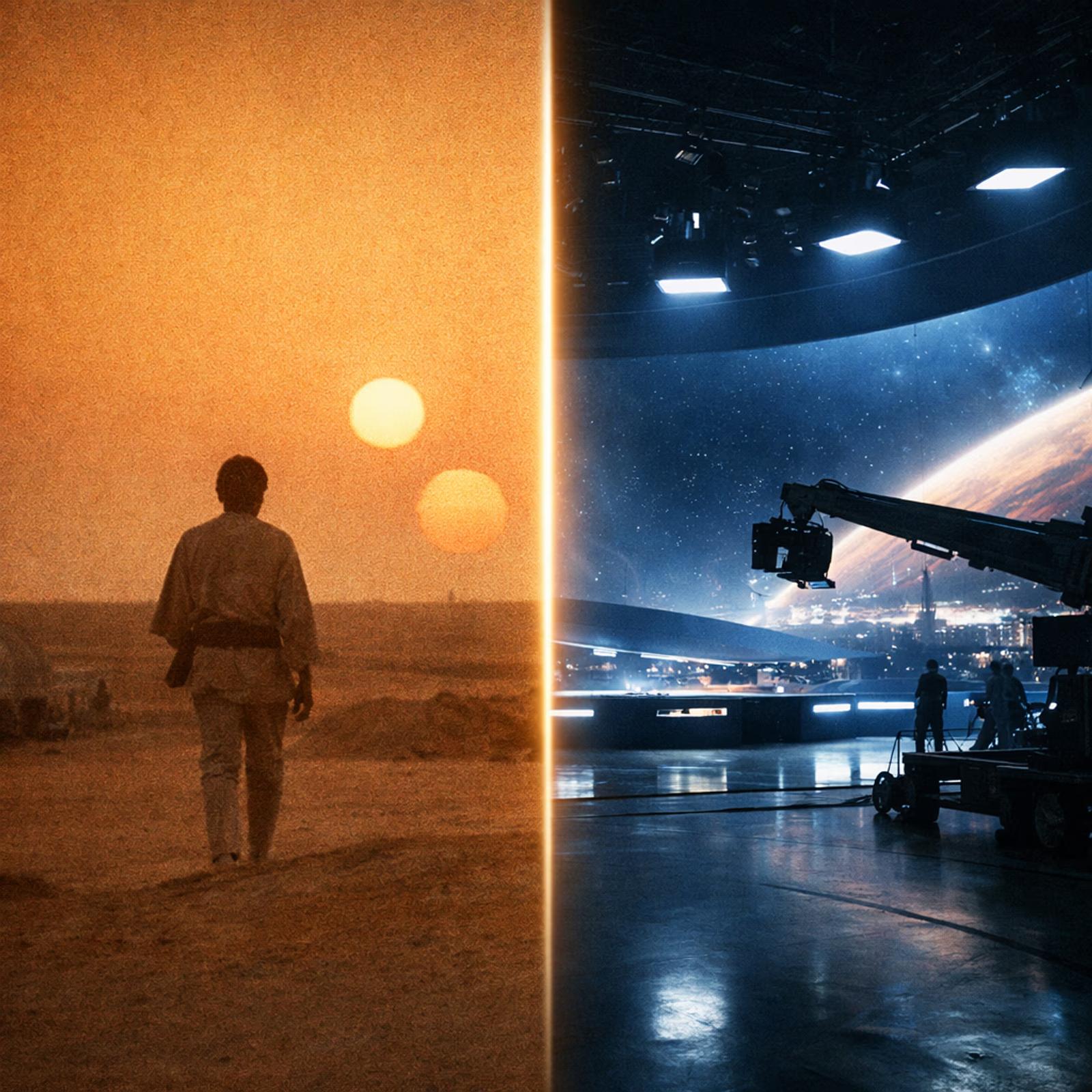
Few films have shaped modern entertainment the way Star Wars did. When George Lucas released the original film in 1977, it wasn't just a movie; it was a blueprint for how to tell a myth, build a universe, and turn that universe into a business.
Nearly five decades later, the franchise sits under Disney and faces a different kind of challenge: not relevance, but sustainability. How do you keep a mythology fresh without diluting it? How do you serve a multigenerational fanbase that wants both nostalgia and novelty?
This piece breaks down how Star Wars rewired storytelling and studio economics, how its influence spread across film and TV, and where the franchise is likely headed next.
How Star Wars Changed the Rules
Star Wars didn't just succeed; it restructured how studios think about a film's value. Three areas stand out:
1. Merchandising as a Business Model
- Lucas reportedly traded his director's fee for merchandising and sequel rights — rights Fox gave up because nobody thought toys would matter.
- The 1977 Kenner "Early Bird Certificate Package," a placeholder toy set sold before the actual products existed, became a landmark in entertainment history.
- It proved that audiences' appetite for a film's world could be monetized well beyond the cinema, and that scarcity of product was its own marketing tool.
2. Mythic Storytelling Structure
- Lucas deliberately grounded Star Wars in Joseph Campbell's Hero's Journey, the same mythic structure found in ancient epics and modern literature alike.
- His goal, in his own words, was to tell "old myths in new ways."
- This gave the franchise a universality that pure science fiction often lacks. It wasn't a space opera. It was a hero's story that happened to be set among stars.
3. VFX as a Language
- Industrial Light & Magic (ILM) was founded in 1975 specifically to build the effects for Star Wars.
- The Dykstraflex, a computer-controlled motion camera, enabled complex, repeatable miniature compositing that didn't exist before.
- ILM didn't just support the film. It created an entirely new discipline that shaped visual storytelling for the next generation of filmmakers.
"Star Wars didn't borrow from Hollywood — it built the template that Hollywood would spend the next 50 years following."
The DNA It Passed On
Star Wars' influence on later cinema isn't really about imitation. Most films didn't copy it — they absorbed its methods. Here's how that inheritance shows up across different formats:
In Film
- The "hero initiation" structure became a standard blockbuster scaffold: an ordinary protagonist pulled into an extraordinary conflict, learning the rules of a new world.
- Films that lean on this most directly include: The Matrix, Harry Potter, Avatar, Dune, Guardians of the Galaxy, and Ready Player One.
- World-building as a product category, expansive fictional universes with their own visual language and internal rules, became an audience expectation, not just a creative choice.
In TV and Animation
- Star Wars helped establish the value of internally consistent "systems" — clear rules for powers, factions, and gadgets that sustain long-form storytelling.
- Shows like Avatar: The Last Airbender, Ben 10, and Teenage Mutant Ninja Turtles all run on a similar engine: defined characters, escalating stakes, and a world whose rules the audience internalizes and cares about.
- Jenkins and other media scholars describe Star Wars as the model for transmedia franchising — stories that extend across films, games, novels, and merchandise, where each format becomes its own entry point.
The Disney Era: More Stories, Different Stories
When Disney acquired Lucasfilm in 2012, it framed the deal around Star Wars as a multi-platform engine film, TV, theme parks, interactive entertainment, and consumer products. The plan was ambitious. The execution was mixed.
What Went Right
- The Mandalorian launched on Disney+'s opening day in November 2019 and proved Star Wars could tell quieter, serialized stories without losing its emotional core.
- It also introduced StageCraft — ILM's real-time LED volume technology — which changed how live-action TV production works, industry-wide.
- Andor demonstrated that the Star Wars brand can carry prestige drama. Critics called it a show where "the Force is AWOL" — a political thriller set in the Star Wars universe that had more in common with serious television than space adventure.
- Rogue One proved a war film could live comfortably inside the franchise. Star Wars: Visions showed international animation studios could bring entirely different aesthetics and sensibilities to the universe.
What Got Complicated
- The sequel trilogy delivered massive box office returns but divided the fanbase in ways the original trilogy never had.
- Solo underperformed, prompting a pullback from theatrical releases and a pivot toward streaming.
- Disney CEO Bob Iger later admitted the company had "invested too much" in streaming and "tried to tell too many stories," a rare acknowledgement that volume can work against a mythology built on scarcity.
Pre-Disney vs Post-Disney: What Changed
The two eras reflect fundamentally different approaches to the same franchise:
- Release rhythm: Release rhythm:
- Release rhythm: The Lucas era moved slowly, films separated by years, each one an event. The Disney era is defined by constant output across streaming and cinema.
- Creative control: Lucas had a single vision at the centre, however inconsistent. The Disney era runs through a larger corporate pipeline. The recent handoff from Kathleen Kennedy to Dave Filoni signals another recalibration.
- Tonal range: The original and prequel trilogies stayed within a consistent register: myth-adventure, earnest and operatic. The Disney era spans western serial, political thriller, experimental anthology, and family adventure — sometimes simultaneously.
- Merchandising model: The original era invented the toys-as-event playbook. The Disney era runs on streaming-era virality. Baby Yoda merchandise became a cultural phenomenon within weeks of The Mandalorian's debut.
- Audience engagement: Theatre-led fandom with long-tail books, comics, and games. Now: always-on engagement loops tied to subscriptions, social media, and character virality.
The Nostalgia Trap — and the Way Out of It
The biggest risk facing Star Wars isn't irrelevance. It's mistaking recognition for renewal.
The Risk
- The Force Awakens sparked a genuine debate about whether cinematic nostalgia had become its own genre and whether familiar faces and callbacks could substitute for storytelling.
- Platform economics make this worse: streaming incentivizes volume, but mythic franchises need scarcity to maintain cultural weight.
- Iger's admission about "too many stories" is the clearest signal that Disney recognizes the tension, even if it's still navigating it.
The Opportunity
- Andor and Visions proved the Star Wars brand can contain grounded drama and stylistic experimentation without breaking.
- They work not because they look like Star Wars, but because they're good on their own terms.
- That's a more sustainable model than endless saga chapters, fewer releases, each one justified by genuine creative ambition rather than franchise obligation.
The franchise's long-term value was never about the number of stories it tells. It's about the feeling those stories create — the sense that this universe is worth caring about.
Marvel and Star Wars: Adjacent, Not Merged
The question of a Marvel–Star Wars crossover surfaces periodically. The honest answer: unlikely, and probably for good reason.
- Collaboration already exists in publishing. Lucasfilm moved the Star Wars comics license from Dark Horse to Marvel in 2015.
- Kevin Feige was reportedly approached to develop a Star Wars film around 2019. That project never moved into active production.
- Feige has publicly downplayed a canonical continuity crossover, and that's the sensible position. Both universes have carefully built internal logics. Merging them creates more problems than it solves.
- The most plausible future collaboration is adjacent: shared production technology (ILM serves both), talent moving between franchises, cross-platform publishing — not an Avengers-meets-Jedi narrative merge.
What Comes Next: 2026 to 2030
Disney's January 2026 announcement of a theatrical return with films targeted for May 2026 and May 2027 suggests the studio is trying to rebalance. Dave Filoni's appointment signals a preference for creative stewardship over pure output.
The healthiest version of Star Wars between now and 2030 probably looks like this:
- Fewer theatrical releases are treated as events, not content drops.
- A smaller number of streaming series that earn their place through creative risk, not franchise obligation.
- Animation and anthology formats (like Visions) continue to serve as creative laboratories.
- Less nostalgia dependency, new characters, new corners of the universe, new reasons to care.
Star Wars survived the prequels, survived the sequel trilogy's divisions, and remains culturally alive nearly fifty years after a farm boy looked at twin suns and imagined something bigger than himself. That's not an accident. It's a testament to how deep the mythic foundation runs.
The question now is whether Disney has the discipline to build on that foundation — rather than mine it.