
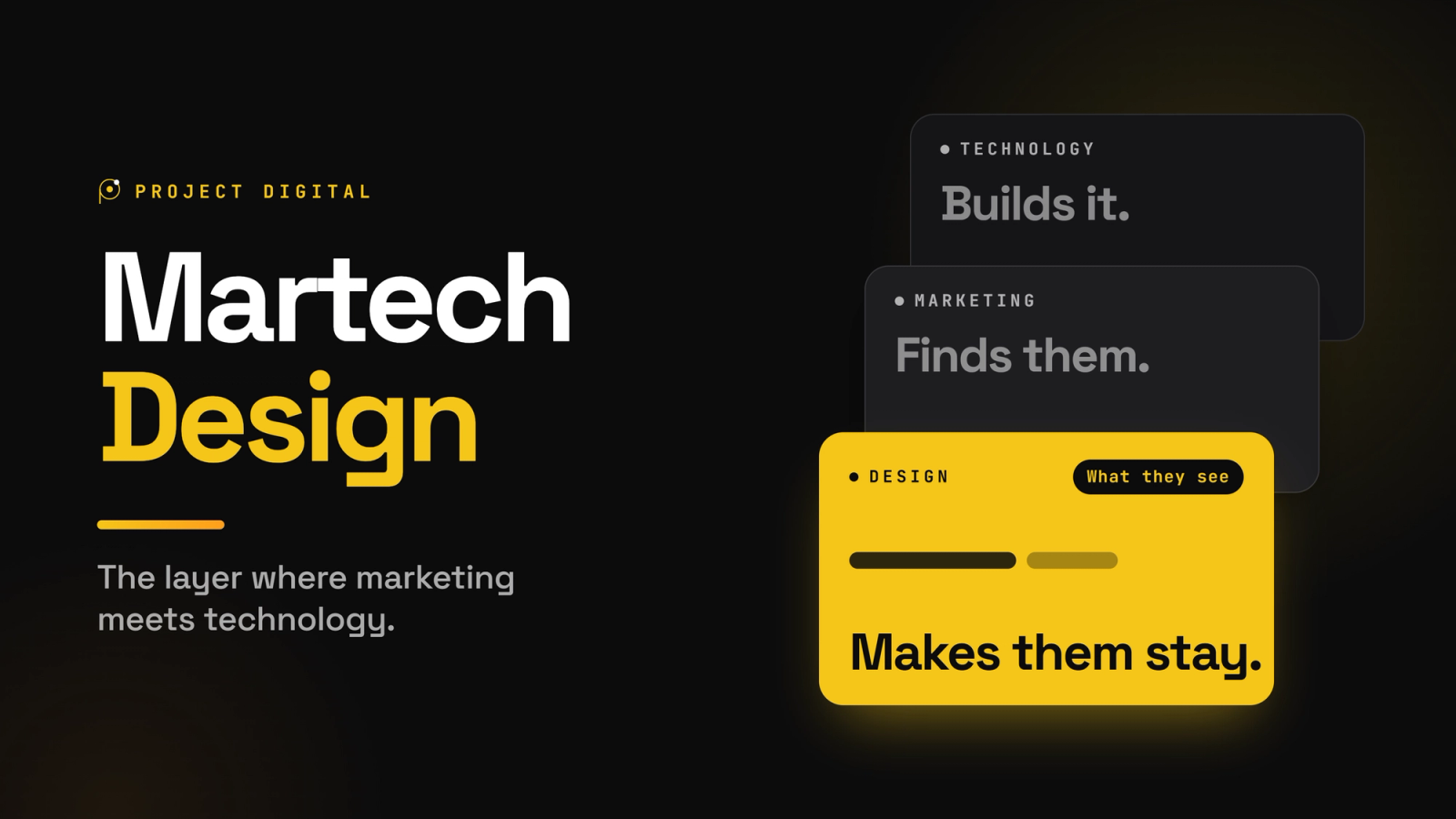
"Marketing finds them. Technology builds it. Design makes them stay."
The pitch, the funnel, the dashboard. Marketing has never had more to work with.
The 2025 martech landscape lists 15,384 tools. That's up 9% in a year. The first version of that map, back in 2011, had about 150. And 77% of the newest additions were AI-native.
So why do marketers use only 49% of what their stacks can do? That's Gartner's 2025 number.
What is martech, really?
Look at it through the customer's eyes. They don't see a stack. They see an ad, a page, a form, an email. Nothing else.
Start with the simple version:
- Marketing: work out what your chosen audience needs and wants, and how to satisfy it.
- Sales: move them from the lead stage to the conversion stage.
- Technology: build it for the niche you found.
Put those together and you get martech.
Where martech design comes in
Then comes the third one. Design. How the product looks, reads and feels when it finally reaches the customer. The most pleasing, most presentable version of what you built.
It's the bridge between marketing and technology. And it's the only part the customer can actually see.
Technology is what you build. Design is what they remember.
The real problem is friction
Gartner's 2022 survey of 324 marketers named three blockers:
- Overlapping tools (30%)
- A shortage of talent to drive adoption (28%)
- A complicated ecosystem (27%)
Not one of those is a missing feature. All three are friction.
What the numbers say about design
McKinsey looked at 300 listed companies over five years. The top quartile on its Design Index grew revenue 32 percentage points faster than their peers. Shareholder returns grew 56 points faster. It's a correlation, not a promise.
The strange part? The second, third and fourth quartiles barely differed from each other. Average design earned almost nothing. Only the top quartile pulled ahead.
Design is moving into the tools
Figma Buzz lets designers publish branded templates with locked layers, so marketers can make on-brand assets by themselves. Canva's team plans lean on Brand Kits and approval workflows.
Design isn't a department you queue behind anymore. It's built into the tool.
One lead, four decisions
Follow a single lead and count:
- The ad makes a promise.
- The landing page keeps it or breaks it.
- The form asks for too much, or just enough.
- The follow-up email looks like the same brand, or a stranger.
Technology runs every step. Design wins or loses every step.
What the pattern says
1,211 tools vanished from last year's map. That's 8.6% churn. The survivors won't be the ones with the longest feature list.
Building keeps getting easier. That's exactly why the experience becomes the difference.
Did your customer notice the 15,384th tool? Or did they notice the page that made it easy to say yes?
So who designed the part of your stack your customer touches first? And does it deserve their trust?
FAQ
What is martech design? It's the design of the marketing technology experience, from landing pages and forms to dashboards and brand templates. It makes tools easy for teams to use and persuasive for customers.
Why does design matter in marketing technology? Tools only create value when people use them, and customers convert on what they experience. Gartner reports 49% stack utilization, and McKinsey found top design performers grew revenue faster.
How many martech tools are there? The 2025 landscape from chiefmartec and MartechTribe counts 15,384 solutions, up 9% on the year before.
Does better design guarantee higher revenue? No. McKinsey's study found a correlation between strong design practice and faster growth, not a guarantee.
— Project Digital