
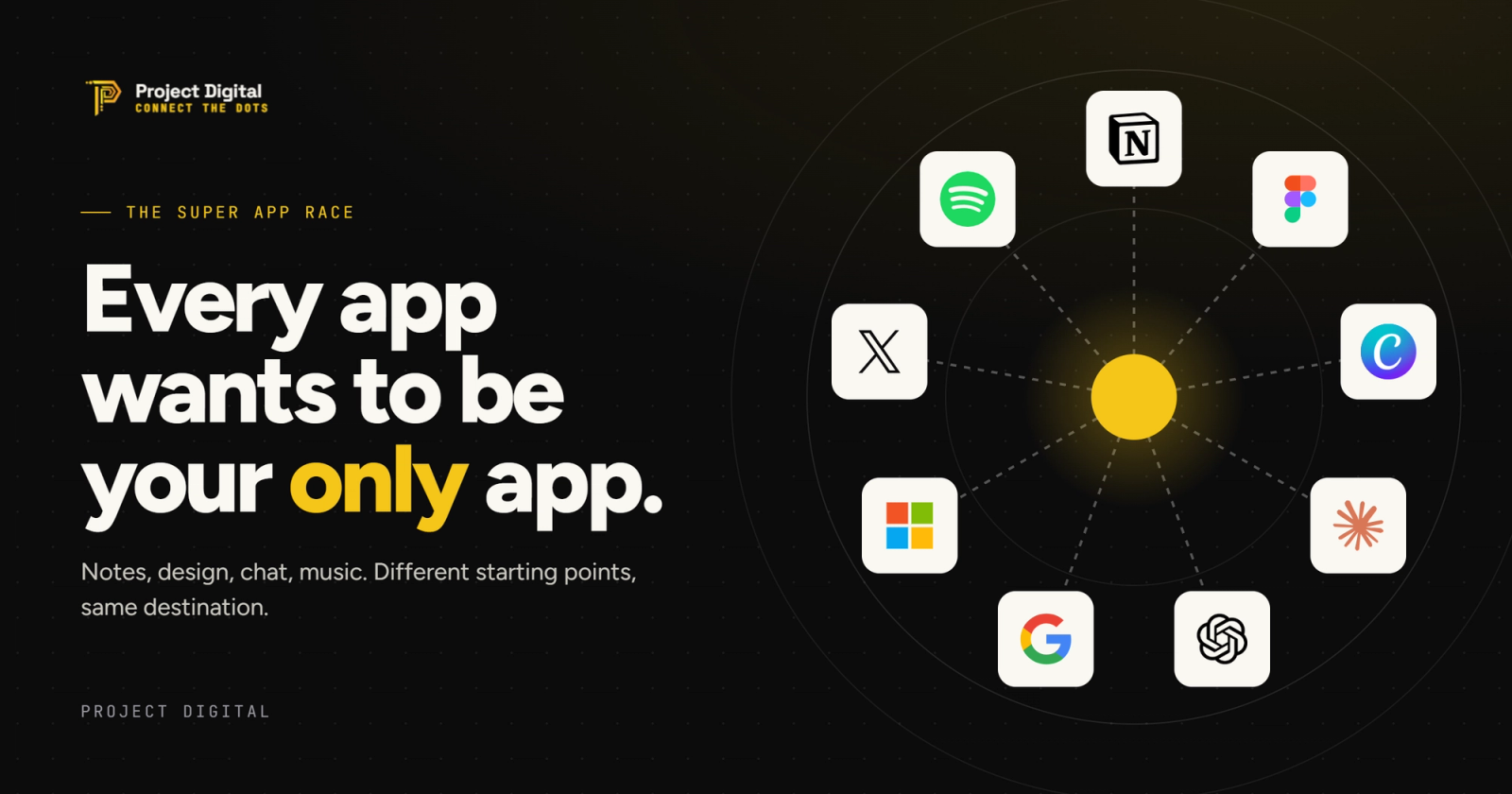
Open your dock and count the overlap.
Your notes app has a calendar. Your design tool hosts websites.
Your chatbot builds software.
Nobody announced it, but somewhere along the way every tool you use decided it should be the only one you need.
The super app was supposed to be a WeChat thing: chat, pay, book a taxi, all inside one icon.
The West never built one. Instead, every app is quietly growing into one, starting from whatever corner it was born in.
Where they started, where they're heading
- Notion began as notes. It now has Notion Calendar, Notion Mail, project databases, and Custom Agents that work across your inbox and schedule. It wants to run every department, not just the one taking notes.
- Figma began as interface design. It now publishes live websites through Figma Sites, turns out on-brand marketing assets with Figma Buzz, adds motion, and builds apps from a prompt with Figma Make. Design file to hosted product, one tab.
- Canva began as easy graphics. It now plans, schedules, and tracks social posts across platforms and runs team collaboration. For plenty of small agencies, it's already the studio, the content calendar, and the approval desk.
- Claude began as a chatbot. It now writes and runs code as an agent, makes designs, docs and decks, and works across your files and apps like a workspace.
- ChatGPT took the same road: chat, then images, then a coding agent, then its own browser, Atlas, where agent mode can shop and fill in forms for you.
- Google has a tool for nearly every job (Gemini, Docs, Tasks, Analytics, Firebase) and keeps threading AI through all of them.
- Microsoft pairs Copilot in Office with Designer for visuals and Clipchamp for video, an everyday-creator suite bolted onto the productivity one.
- X added a wallet. X Money rolled out to US subscribers this July with payments and a debit card, Musk's "everything app" finally holding money.
- Spotify went from music to podcasts to audiobooks, chasing every minute you spend listening.
Different starting points. Same destination.
Why everyone is building the same thing
AI made features cheap. A calendar or a website builder used to be a multi-year bet. Now a model gets you a working first version fast. When building is cheap, expanding becomes the obvious move.
Switching is the real competitor. Every time you export a file and open another app, you might not come back. Owning the next step in your workflow keeps you inside.
Companies pay more than people. Selling one designer a tool is a subscription. Selling a whole company a workspace is a contract. Notion pitching every department and Canva courting agencies is the same play: grow from one user to the org chart.
The catch
When every app does everything, most of them do most things at 70%. A built-in scheduler is fine until you need serious analytics. A built-in inbox is fine until email is your actual job.
Then comes overlap fatigue. Your team ends up with four places to leave a comment, three calendars, two AI assistants, and nobody sure which one holds the truth.
So the super app race probably doesn't end with one winner. It ends with each of us picking a home base and treating everything else as features we ignore.
The pattern
Last time on Project Digital we saw that "rivals" share one supply chain. This is the other half of that story: they're converging on one product, too. A workspace with AI in the middle and your work arranged around it. The logos differ. The shape doesn't.
The question isn't which app becomes the super app. It's which one you let become yours.
So what's your home base?
FAQ
What is a super app? A single app that bundles many services, like messaging, payments, work tools, and content, so users rarely need to leave it.
Why are apps like Notion, Figma and Canva adding so many features? AI makes new features faster to build, and every extra step they own keeps users and teams from switching to another tool.
Is an all-in-one app better than specialist tools? For light use, often yes. For work that is central to your job, specialist tools usually still go deeper.
— Project Digital