
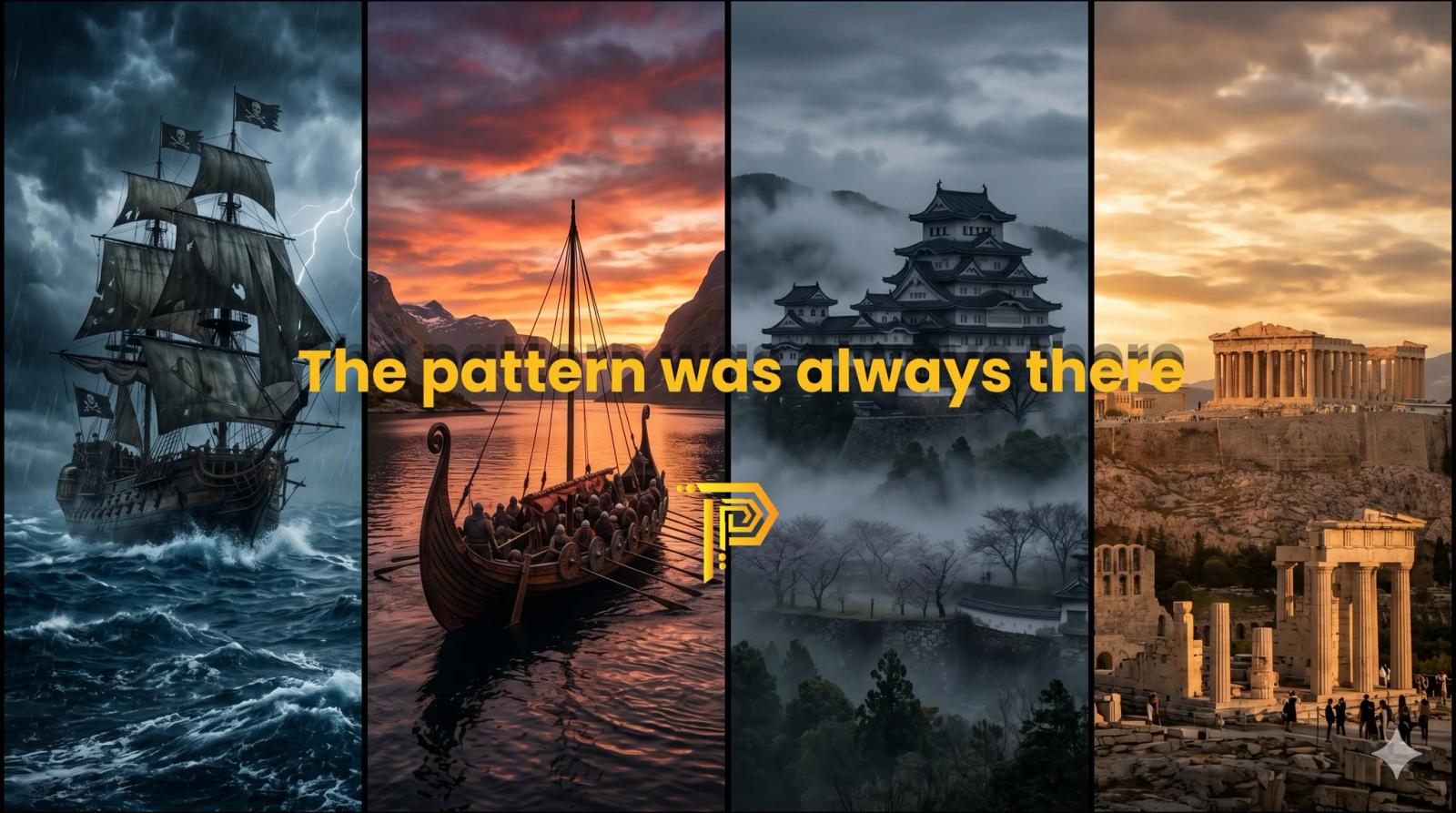
Let's get one thing straight.
Assassin's Creed is not just a video game franchise. It is a time machine, a mythology encyclopedia, and apparently — a very accurate crystal ball. Because if you've been paying attention, Ubisoft has been quietly recreating movies and TV shows before they even exist. Or remixing ones that do. And doing it with a hidden blade and absolutely zero shame.
Don't believe us? Strap in. This is going to feel uncomfortably familiar.
Jack Sparrow Called. He Wants His Ship Back.
Let's start with the obvious one.
Assassin's Creed Black Flag (2013) dropped players into the Golden Age of Piracy — rum-soaked islands, naval battles, sea shanties you'd hum in the shower for weeks, and a morally flexible protagonist who was more pirate than assassin and somehow more likeable for it.
Sound familiar?
Pirates of the Caribbean had already given the world Jack Sparrow in 2003, and the franchise was very much alive and well when Black Flag arrived. Ubisoft basically looked at what Disney was doing with pirates, said "we can do that but let you play it," and proceeded to make one of the greatest pirate experiences ever put to screen or controller.
The result? Black Flag felt like a Pirates of the Caribbean game that Disney forgot to make. Naval combat, buried treasure, charismatic rogues, and just enough supernatural nonsense to keep things interesting. If you ever wanted to be Jack Sparrow without the hangover, Black Flag had you covered.
The Vikings Were Already Here
Assassin's Creed Valhalla (2020) sent players raiding across England as Eivor — a Viking warrior with an identity crisis, a very large axe, and an inexplicable connection to Norse gods. It was brutal, beautiful, and absolutely obsessed with the mythology of Odin, Thor, and Loki.
Then, one year later in 2021, Netflix dropped Vikings: Valhalla.
Same name. Same world. Same energy. Two different media arriving at the same cultural moment like two people showing up to a party in identical outfits. Except one of them was a hundred-hour open-world RPG.
And before Netflix's Valhalla, there was already History Channel's Vikings — which ran from 2013 to 2020, right alongside the peak AC Valhalla hype cycle. Ubisoft didn't copy Vikings. Vikings didn't copy Ubisoft. They were all just drinking from the same Norse mythology well and hoping nobody noticed.
The gods were always going to trend. It was only a matter of time before Odin showed up in your game library and your Netflix queue simultaneously.
Shadows and the Samurai Obsession
Assassin's Creed Shadows (2025) arrived in feudal Japan, giving players two protagonists — a shinobi and a samurai navigating political intrigue, honour codes, and the kind of atmospheric world-building that makes you want to just stand in a bamboo forest and do nothing for twenty minutes.
Meanwhile, FX's Shogun — which came back in 2024 and absolutely dominated awards season — was doing the same thing on television. Feudal Japan. Political tension. The collision of cultures. The weight of honour and loyalty as a lived, daily burden.
Both Shadows and Shogun are obsessed with the same question: what does it cost a person to survive inside a system built on rigid loyalty? One asks it through a television drama. The other asks it through stealth mechanics and a katana. Same question, different controllers.
Baghdad Was Always Going to Have a Moment
Assassin's Creed Mirage (2023) took the series back to its roots — literally — by setting the story in 9th-century Baghdad during the Islamic Golden Age. A street thief. A sprawling, beautiful city. Ancient secrets buried beneath the bazaar.
If that sounds like Aladdin grew up, got radicalised by a secret society, and started reading philosophy, you're not entirely wrong.
The Golden Age of Baghdad is one of history's most underrated settings, and Ubisoft knew exactly what they were tapping into. A world of scholars, merchants, thieves, and power — all tangled together in a city that was, at its peak, the intellectual capital of the planet. Mirage made that world feel like somewhere you'd actually want to live. Right up until someone tried to assassinate you.
And Then There's This Guy Called Homer
Here's where it gets genuinely interesting.
Assassin's Creed Odyssey (2018) sent players to ancient Greece. You sailed the Aegean. You fought the Cyclops. You argued with gods who had the emotional maturity of toddlers with unlimited power. You uncovered the story of a warrior trying to find their place in a world shaped by forces bigger than any single person.
Eight years later, Christopher Nolan — yes, that Christopher Nolan, the Oppenheimer one — is releasing The Odyssey on July 17, 2026.
Same world. Same mythology. Same Cyclops (presumably less of a boss fight, more of a cinematic nightmare). With Matt Damon as Odysseus, Tom Holland, Anne Hathaway, Zendaya, Charlize Theron, and a $250 million budget shot entirely on brand new IMAX 70mm technology.
Ubisoft built the trailer. Nolan just made the movie.
And here's the kicker — Nolan has said himself that all the films he's ever made trace back to The Odyssey. It's foundational. It's the story underneath every other story. Ubisoft knew that in 2018. Nolan is making it official in 2026.
So What's Actually Going On Here?
The pattern is this: great stories don't belong to one medium.
Ubisoft has spent over fifteen years proving that the best historical and mythological settings are magnetic — they pull every medium toward them eventually. Sometimes the game comes first and the show follows. Sometimes the movie exists and the game makes it playable. Sometimes they arrive simultaneously like the Viking situation and just nod awkwardly at each other across the cultural landscape.
The point isn't who got there first. The point is that certain stories have so much gravity that everyone gets pulled in sooner or later.
Pirates. Vikings. Samurai. Greek gods. Baghdad nights.
Assassin's Creed didn't predict the future. It just understood, very early, which stories people were always going to want to live inside.
Go Watch Nolan's Odyssey
All of this brings us, naturally, to July 17, 2026.
If you played AC Odyssey — you already know this world. You've sailed those seas. You've met those gods. You know what Odysseus is up against and you know the kind of epic that Homer had in mind when he wrote the whole thing down 2,700 years ago.
Now go watch Christopher Nolan do it on the biggest screen you can find.
This is not a regular summer blockbuster. This is the most anticipated film of the year, shot with technology that has never been used in cinema before, directed by a man who has been quietly building toward this story his entire career.
The game gave you the controller. The movie is going to give you the chills.
The Odyssey. In theaters July 17, 2026. IMAX if you can get a seat — they're already selling out.
Project Digital tracks the patterns between technology, media, and entertainment — because the connections are always there if you know where to look. Follow along.